
Why Tauranga City Council stockpiled, then removed, 10,000 cubic metres of dirt in Pāpāmoa
Regional Content Leader·Bay of Plenty Times·
5 Feb, 2020 09:00 AM3 mins to read
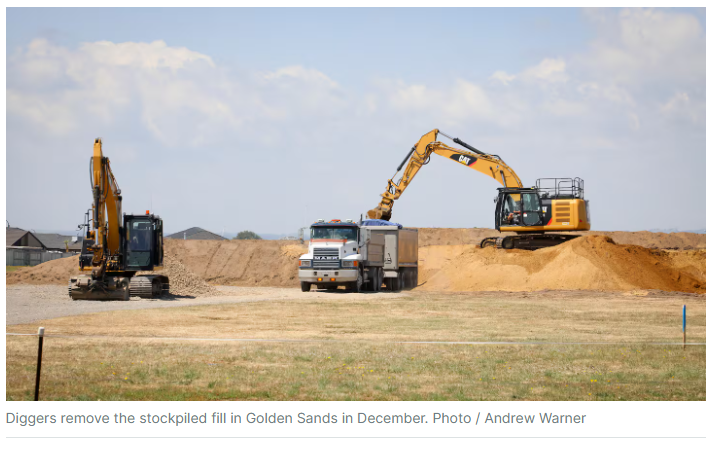
Diggers remove the stockpiled fill in Golden Sands in December. Photo / Andrew Warner
Plans fora new tsunami refuge in Pāpāmoa East have been abandoned.
Over summer Tauranga City Council had removed a mound of dirt fill it had stockpiled for the high-ground evacuation refuge at the intersection of The Boulevard and Golden Sands Dr.
The mound had been there for more than a year after being collected during the Te Okuroa Dr build.
The council previously told the Bay of Plenty Times the fill was for another vertical evacuation structure like that in Gordon Spratt Reserve - a terraced area of raised land people can take refuge on during a tsunami.
READ MORE:
• Tsunami real threat to the Bay
• Tsunami alert systems for coastal Tauranga up in the air - again
• Do you know what to do in a tsunami? Bay residents urged to look at new warnings
• Questions raised over tsunami warning system following Bay of Plenty false alarm
When the $1 million structure - the first of its kind in the Southern Hemisphere and an award-winner - was opened in the reserve in 2018, the council had plans to build three more including one at Golden Sands. It was to form part of the grounds of a new primary school being established on The Boulevard site by Catholic Diocese of Hamilton.
But new central Government guidelines have the council rethinking that plan, and it has already redirected the budget towards 12 tsunami sirens.Community services general manager Gareth Wallis said the council was "reviewing [its] approach to tsunami risk management".
The most recent government advice, he said, was that vertical evacuation structures (VES) should be a "last-resort measure".
The Ministry of Civil Defence and Emergency Management (now known as the National Emergency Management Agency) put out new guidelines in December 2018.
"We are reviewing our approach to tsunami risk management and VES are part of that review," Wallis said.
"We haven't decided yet whether to continue using vertical evacuation structures like the one at Gordon Spratt Reserve."
Asked if any new modelling or information had changed the expected effectiveness of the Gordon Spratt refuge, Wallis said it remained an evacuation refuge and while new inundation modelling and further risk reviews had started, the work would take several months to finish.
He said the council agreed to remove the stockpile of fill Golden Sands after agreeing with the property owner that piece of land would no longer be used for a refuge.
About 10,000 cubic metres of fill was removed from the site at no cost to the council.
A National Emergency Management Agency spokesperson said the tsunami vertical evacuation structures were considered a last resort option, if timely evacuation out of tsunami evacuation zones is not possible.
"Evacuation out of all tsunami evacuation zones should always be the first option."
The Government was also working on design criteria for vertical evacuation structures, which could include buildings designed to withstand a tsunami - something other coastal New Zealand councils have expressed interest in.
Pāpāmoa Residents and Ratepayers Association chairman Philip Brown said a tsunami was something people living in Pāpāmoa worried about.
He said an audible warning system was needed as soon as possible. People also needed to know where to go and assemble and, in flat Pāpāmoa, it made sense to identify and potentially build areas of high ground.
He believed the community also needed to have a practice evacuation, to expose flaws in the system, educate people and start a community conversation.